Wrinkling, bowing, or twisting. The part is telling you it wasn’t supported, or the tonnage wasn’t even across the bed. Long parts need support arms — gravity plus bending force will distort anything left hanging. Uneven pressure, from cylinder misalignment or valve issues, warps parts the same way.
Surface marks and indentations. The quietest defect, and the most embarrassing: the tooling was dirty. Under tons of force, even a speck of debris or a dried oil spot prints itself permanently onto the part. Clean the tooling before every setup. It takes a minute; rework takes a shift.
The tooling deserves its own chapter
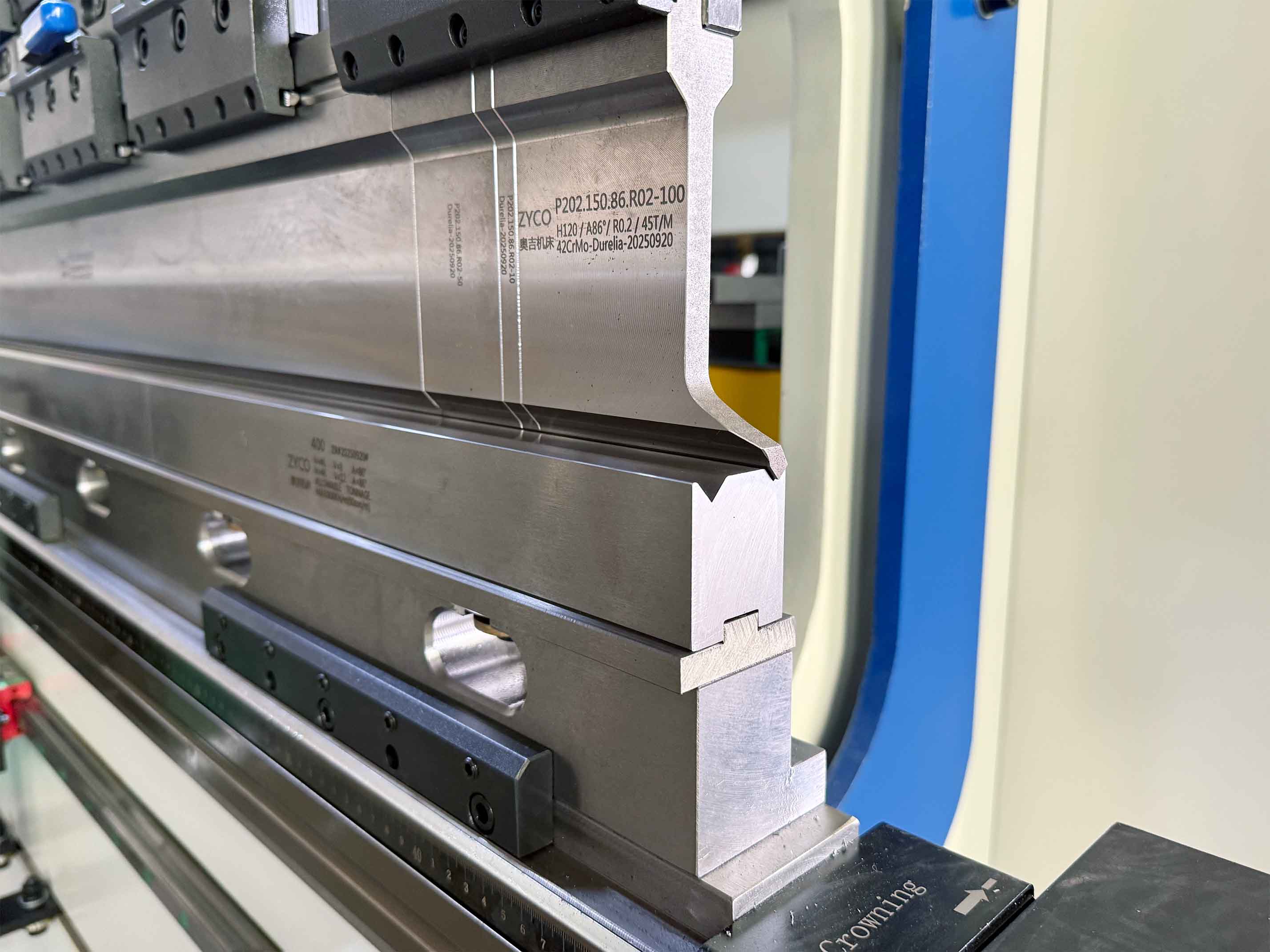
The punch and die are where the machine’s power meets the workpiece, and most defects are born in that contact zone. Misaligned tooling — punch and die not centered along the bed — produces uneven angles and stresses parts unevenly. Worn tooling does the same more gradually: a rounded punch tip or an eroded die shoulder changes your geometry a little more every week until parts start failing inspection.
And then there’s simply the wrong tool for the job. Tooling matched to air bending behaves badly when forced into bottoming work, and the tonnage penalty for the wrong choice punishes the whole machine — hydraulics, guides, and all. Inspect tooling on a schedule, not when parts start failing. By then you’ve already paid for the scrap.
Listen to the machine, too
Defects on the part are only half the conversation. The machine talks as well: a new vibration, a changed sound, a backgauge that drifts a little more each week, hydraulic oil running hotter than it used to, an alarm that keeps coming back. Recurring alarms are not noise — they’re the control system telling you its tolerances have shifted. Write these things down. A logbook turns vague unease into a trend you can act on before it becomes downtime.
Make diagnosis a habit, not a fire drill
The shops with the fewest bending problems aren’t the ones with the best machines — they’re the ones with the best habits. First-piece inspection after every setup change. A pre-shift walk-around: oil, leaks, tool alignment, backgauge. Check the simple things first when something goes wrong — loose connections, fluid levels, a program that was never dry-run. Most "mysterious" defects turn out to be something ordinary that nobody checked.
Stop guessing, start reading. The bend already told you everything.
Talk to ZYCO’s engineers about bending process setup and troubleshooting — most defects
are solved faster with a second pair of experienced eyes.





 Network Supported
 English
 français
 Deutsch
 italiano
 русский
 português
 español
 한국의
 Türkçe
 العربية