
Imagine this situation:
A sheet metal part has been designed, programmed, laser cut, and sent to the press brake. Everything appears correct on the drawing, and the bending process runs smoothly. However, after bending, the finished component doesn't match the intended dimensions. Mounting holes are slightly out of position, assembly gaps appear, or the final product simply doesn't fit as expected.
For many fabrication shops, these issues are frustratingly familiar.
What's even more frustrating is that the bending operation itself is often not the cause of the problem. In many cases, the root cause can be traced back to the flat pattern design stage.
Before a sheet metal part is cut, manufacturers must determine how the material will behave during bending. Different materials, thicknesses, bend radii, and tooling setups can all influence the final dimensions of a formed component. If these factors are not considered during development, even a perfectly executed bending process may produce an inaccurate result.
This is why modern sheet metal manufacturers place increasing emphasis on flat pattern accuracy and digital engineering tools. By evaluating critical bending parameters before production begins, engineers can improve dimensional consistency, reduce material waste, and avoid costly production errors.
In sheet metal fabrication, the quality of the finished part is largely determined before the material ever reaches the press brake.
The flat pattern serves as the foundation for every subsequent manufacturing process, including:
If the developed blank size is inaccurate, dimensional issues can continue throughout the entire production workflow.
Even small deviations can create significant problems when producing precision components such as:
As product complexity increases, accurate flat pattern development becomes increasingly important.
Sheet metal does not behave like a rigid object when it is bent.
As the material forms around a bend, different areas of the sheet experience different levels of stress. Some areas are compressed, while others are stretched. This natural deformation changes how the material occupies space before and after bending.
The amount of deformation can vary depending on several factors, including:
Different materials respond differently during forming operations.
For example:
Each material has unique forming characteristics that influence the final dimensions of the part.
Thicker materials generally behave differently than thinner sheets during bending.
As thickness changes, so does the relationship between the flat pattern and the finished component.
The selected bend radius directly affects how the material flows during the bending process.
Tighter bends often require greater attention during design and process planning.
Punch and die selection can significantly influence the final outcome of a bending operation.
Using different tooling combinations may result in different dimensional results even when working with the same material.
Many fabrication issues can be traced back to incorrect development data.
Some of the most common problems include:
Parts may appear visually correct but fail to fit properly during assembly.
This often results in additional rework and production delays.
Holes, slots, and cutouts located near bend lines may shift from their intended positions after forming.
Incorrect blank sizes frequently lead to rejected parts and unnecessary scrap.
Operators may spend valuable production time modifying programs and making corrections to compensate for dimensional errors.
Over time, these issues can significantly impact profitability and production efficiency.
As manufacturing tolerances become tighter and customer expectations continue to increase, relying solely on manual references or past experience is often no longer sufficient.
Modern fabrication companies increasingly use digital engineering tools to support design and production planning.
A professional Bend Allowance Calculator helps engineers evaluate important bending variables before production starts, allowing them to make better decisions regarding:
Rather than discovering dimensional problems after bending, manufacturers can identify potential issues much earlier in the process.
This proactive approach helps improve consistency across projects while reducing unnecessary production risks.
One of the biggest challenges in sheet metal fabrication is maintaining consistency between design, programming, and manufacturing.
When engineering teams and production teams work from the same development standards, the entire workflow becomes more predictable.
Benefits include:
This is particularly valuable for companies producing custom sheet metal components, precision enclosures, architectural metalwork, and industrial equipment.
To help engineers and fabricators improve flat pattern accuracy, ZYCO provides a professional online Bend Allowance Calculator designed specifically for sheet metal applications.
Whether you are designing a new product, verifying production drawings, or optimizing an existing manufacturing process, the calculator can help streamline development and improve production confidence.
Access the Bend Allowance Calculator here:
https://calculator.zycomachine.com/engineering-tools/bend-allowance-calculator
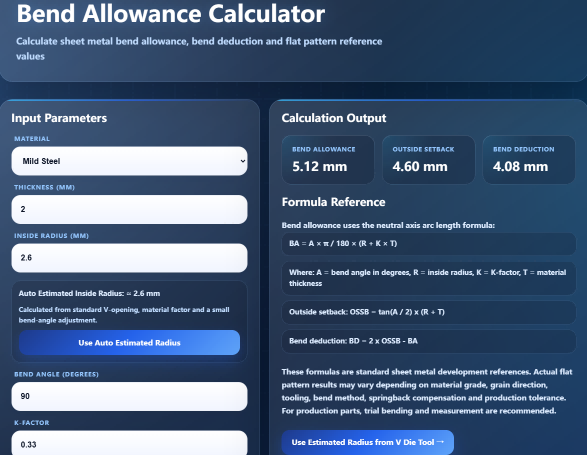
Many engineers use the tool during the design stage to verify bending conditions before releasing drawings for production, helping reduce costly revisions later in the manufacturing process.
To achieve more consistent fabrication results, manufacturers should consider the following practices:
Combining these practices with modern digital tools can help improve both product quality and manufacturing efficiency.
Successful sheet metal fabrication begins with accurate planning.
While bending operations receive much of the attention on the shop floor, the accuracy of the flat pattern often determines whether a project succeeds or encounters costly production challenges.
By understanding how materials behave during forming and by using professional development tools during the design stage, manufacturers can improve dimensional accuracy, reduce waste, and achieve more predictable production results.
For engineers, designers, and fabrication professionals seeking a more reliable approach to sheet metal development, a Bend Allowance Calculator provides a practical way to improve decision-making before production begins.

Leave your email address and requirements, our professional sales team will develop the most suitable solution for you.


Copyright © 2026 Nanjing Zyco Cnc Machinery Co., Ltd. All Rights Reserved.
 Network Supported
 English
 français
 Deutsch
 italiano
 русский
 português
 español
 한국의
한국의 Türkçe
 العربية